One Month In
Rediscovering Buenos Aires and Myself

This last week marked the completion of the first month of our sabbatical adventure, and it’s been a strange experience. I had the idea that once we arrived in Buenos Aires, my brain and body would switch fairly effortlessly to relaxation mode, but it turns out the neural pathways carved through day after day of stress and occupational obligation are harder to reroute than I expected.
This shouldn’t be wholly surprising. After all, a sabbatical is not the same as a vacation. I’ve still been getting up every weekday to write, working against a deadline to get my next book (which I’m co-writing with the fantastic Hollie Nyseth Nzitatira) to press by August 1. But I’ve tried to introduce a new kind of routine into my day. Rather than getting right to work, I start my day as I always do, with my usual Wordle and Worldle puzzles, then read the New York Times. But I’ve now added at least 15-30 minutes of improving my Italian, then 15-20 minutes of meditation. Only after all this do I settle in front of the computer to write. In the first few weeks, I was still checking my emails every day, but this made me realize just how all-consuming these menial things that emerge over email can be. So now I’m only allowing myself to look at emails on Monday and Thursday afternoons, after I’ve gotten some writing done. Apart from that, I’m trying to reserve the afternoons whenever possible for joyful things meant to help me reorient my brain and reset my stress levels. Slowly but surely, I’m getting into a rhythm that doesn’t exactly feel like vacation—I still look forward to weekends— but also doesn’t feel like the non-stop roller coaster of real life.
I’ve been spending some time trying to be the flâneur I always aspire to be. A few weeks ago, during an afternoon stroll, I passed by what used to be called the Buenos Aires Zoo until it was redubbed Ecoparque in 2016. This historic zoo was first opened in the late 1800s and was one of the first zoos in the world to feature animals not in cages, but in habitats that more closely resemble their home environments. It still features a number of pavilions that are reconstructions of Hindu temples and East Asian ruins—a kind of Orientalist EPCOT with animals. I’d never visited before, but found that entry was free after flashing an ID card, so I ended up spending an afternoon walking through the space. It’s not exactly in pristine condition, and some of the exhibits remain sadly vacant, but I was generally surprised at how pleasant the whole experience was. Capybaras roam freely about the zoo, unconstrained by cages. African wildlife like ostriches, giraffes, and hippopotami are on proud display alongside more local fauna, like tapirs, Andean condors, and a puma that was either really good at hiding or not actually in the exhibit at all. I checked several new species of birds off my “Life List” on my Merlin bird ID app, including a few Southern Screamers, a strange looking cross between a bird and a small dinosaur with a wicked shriek that can be heard from great distances.


Last week, on a whim, I asked ChatGPT to create a historic walking tour for me of Palermo, the neighborhood where Tibi and I are staying, and the experiment totally worked. For three or four hours, I wandered around the neighborhood where we’ve stayed so many times before, visiting some places I never knew existed and discovering new things about places I’ve seen unthinkingly countless times. I don’t know how often I’ve walked by the statue of Giuseppe Garibaldi, the hero of Italian Reunification, in Buenos Aires’s Plaza Italia, but I never knew that, before bringing together the various fiefdoms of Italy, he fought for the independence and liberation in Latin America. I’d heard tell of the beautiful Japanese Gardens, but had never visited them myself, until this walking tour told me to do so. I learned about Rosas, the power-hungry dictator who controlled Buenos Aires and, for a period, all of Argentina in the early 1800s before he was defeated on February 3, 1852. And I walked among the statues of dozens of writers, some Argentinian, some international, in the Garden of Poets, which I had never heard of before this walk. It always feels so wonderful to see in a new light spaces you’ve known, to view them through the lens of history and symbol. Walking exactly where ChatGPT tells you isn’t exactly a flâneur’s stroll, but it was satisfying, nonetheless.


Last weekend, we took a trip with our friend and colleague Eugenia to Mendoza, Argentina’s most famous wine region, where we’ve always wanted to go but had somehow missed until now. We spent a beautiful winter weekend visiting boutique vineyards situated under the Andes, which soared above us in all their orange-brown glory. The days were calm and full of delicious sips of so many more varietals than the Malbec that made Mendoza famous. We spent one evening in a bodegón, a traditional neighborhood eatery, where we ate milanesa and watched Argentina wallop Jordan in the World Cup. Our waitress was kind enough to adorn our faces with makeup resembling the Argentinian flag, and Tibi even got a free jersey, though we’re still not quite sure why. It was either because of the wine we ordered or the fact that we were foreigners rooting for Argentina. But what does it even matter?


Despite all these beautiful moments, one thing that’s been particularly difficult about this trip to Buenos Aires is how it has made me confront how much I’ve changed over the years. Fifteen years ago, this was one of my favorite cities in the world. I loved the chaos and the late nights. We had a slew of local friends, all of whom were excited to meet us each night we were in town. We had coffees and dinners, nights drinking and dancing, sometimes until the sun began to rise. All the many things that never worked in Argentina failed to perturb me at all. I made a game of dodging the endless piles of dog shit on the sidewalks, and the drunken teenagers who woke us up at 5 am with their singing was more amusing than it was upsetting. There was something exciting about coming into the country with a pile of US dollars and exchanging it with our arbolito—literally, “little tree,” the Buenos Aires name for a person who exchanges money for you on the semi-official “blue” market—for what felt like dozens of stacks of Argentine pesos, which we would then spend everywhere over the coming weeks so that we’d end up paying less than half of what it was officially supposed to cost. We walked into fancy restaurants with our pockets so full of cash that when we paid the bill, the little folder in which they brought the check couldn’t even begin to close. It was all absurd and frustrating but simultaneously exhilarating.
Now, many of these ludicrous things have gone to the wayside. The exchange rate is terrible, but there’s no real difference between paying with cash from the blue market or using your credit card. For that matter, every place takes credit cards now, and most restaurants even let you add the tip on to the card, which was totally unheard of five years ago. The dog shit on the sidewalks has been replaced with a marked increase in police officers, though there is still certainly a sufficient amount of the former to step in just as you move out of the way of the latter. A trip to the grocery store remains an exercise in futility, as finding even some of the most basic ingredients—spices, especially—is an impossibility here. I had to go to five or six different shops before I could find bay leaves for a stew I was making. And speaking of that stew, I needed to buy a pot in which to cook it. In Buenos Aires, where you can buy five pounds of oranges for one dollar and a kilo of the best steak in the world for just a few dollars more, I spent well over $100 on a simple stock pot.
Most of the changes, however, have not been with the city, but with me. The noise and chaos of the city, which used to excite me, now exhausts me. We actually changed apartments two weeks after our arrival because I couldn’t sleep, owing to all the traffic noise outside our window. Now we’ve moved into a second apartment that is, lamentably, even louder. (Please remember, this from a guy who lives in Manhattan!) I can’t go out dancing until dawn anymore, of course, but this is also ok, because neither can our friends here. In reality, because most of them now have children and because the economy is so terrible, they can’t even go out for dinner most nights, which has led to some real changes in how we experience the city.
All in all, it’s made me realize, for better or worse, how comfortable I’ve grown with being comfortable. I used to relish an overpacked schedule and an always changing landscape. Now, I’m realizing just how much I need to have that balanced with tranquility and routine. I love being social, but I also love sitting at home zoning out in front of the television or reading a good book (without the sounds of diesel-fueled buses endlessly passing outside my window). Losing that balance has been difficult. Realizing how different I am now compared to how I was when I first encountered this city has been equally strange. For my remaining time here, I’m trying to use it as a learning experience…not about the place, but about myself and what I need to be content and productive.
There has been one fantastic thing about being in Argentina these weeks, however, and that is being here during the World Cup, especially one in which Argentina has been consistently winning. The city comes to an almost total standstill whenever Argentina plays. When you watch a match, you can hear entire apartment buildings scream together when Messi scores a goal. The few cars on the road start honking, and people open their windows to yell out into the side streets, as their apartments are simply too small to contain their joy. To experience this exuberance, this phenomenon that is so totally collective, is riveting. It’s like the entire country is breathing in time whenever a match is on.
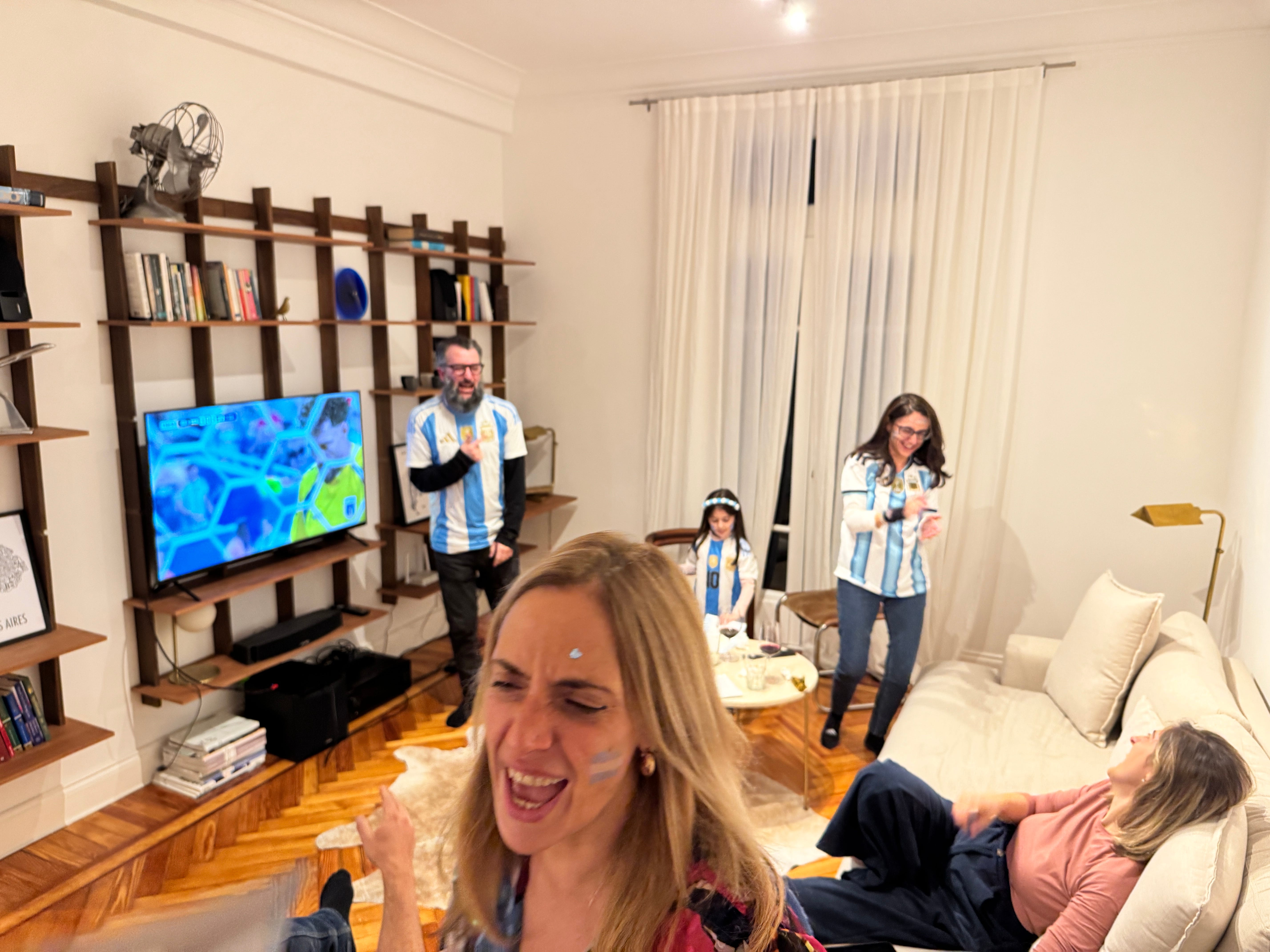
The other night, we had a dinner party where I served the aforementioned stew. Together with our friends, we watched Argentina play Cape Verde—a match that most thought would be an easy win for Argentina, but turned out to be a real nailbiter. There was ecstasy in every goal Argentina scored and absolute agony each time Cape Verde answered in turn. Upon scoring the third goal, which secured Argentina’s victory, our apartment, every apartment in our building, every building on our street, every street in our neighborhood erupted like a volcano. My Apple Watch pinged me with a notification warning me that I was in a loud environment—as if I didn’t know. It was totally thrilling. They say futbol in Argentina is like a religion, but it’s actually something much more. After all, when is the last time a church service has led to the collective exaltations of so many millions of people, celebrating together all at once? It is, I have to say, glorious to be some part of that whole. It makes one feel so big, so small, and so so very lucky, all at once.
On a closing note, I started using this app called 1SE (1 Second Everyday) to document at least one moment from each day of our sabbatical. Here are the highlights from our first month, all condensed into one minute and accompanied by the fantastic Argentinian actress Elena Roger in the most recent Broadway revival of Evita:
A wonderful read of your introspection
❤️❤️❤️Looking forward to seeing your transformation 🍷❤️